The Dark Knight Rises

With Batman Begins and The Dark Knight, Christopher Nolan brilliantly reinvented the iconic character of The Batman. The Dark Knight Rises marks the thrilling conclusion to his trilogy, and the setting of an impossibly high bar for superhero movies, for trilogies/series, and for cinematic storytelling in general.
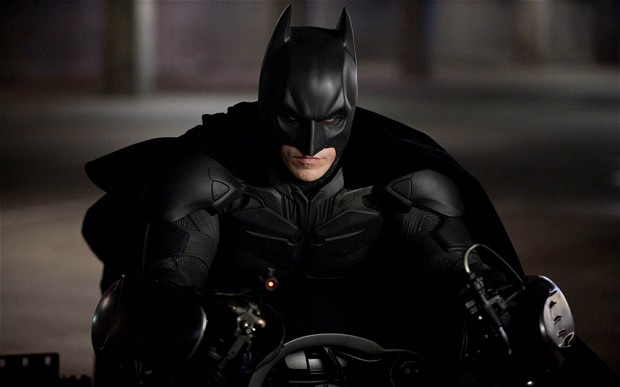
The Batman

The Dark Knight Rises also brings Nolan’s cinematic record to an unheard-of 7 for 7 in great movies.

He announced himself in Hollywood with the twisty ploting and bold structure of Memento; brought an epic and lonely grandeur to the Al Pacino thriller Insomnia; reinvented superheroes with Batman Begins; delivered the uniquely dazzling magician-thriller The Prestige; channeled the brutal scale of Heat and The Godfather to make one of the greatest sequels of all time with The Dark Knight; blew our minds with the extraordinary dream-, perception- and reality-bending Inception.

And now this.

That’s seven era-defining, pop culture-redefining classics in a row.

How did that happen?

It all comes down to Nolan’s magnificent, architectural, kinetic and flat-out rock-solid grasp of how to blend and meld action, character, concept and emotion into one fluidly relentless thrill-ride. He’s a master storyteller, both on the page and up there on the screen. His scripts have an architect’s precision, a powerful, inexorable structure on which he hangs his whole new cinematic language of action and motion. A language which reaches new heights in The Dark Knight Rises.

The scope and complexity of the storytelling in The Dark Knight Rises is thrilling, especially when you look at it in the context of the trilogy as a whole. From the bold creation of the new origin story, to the reimagined diabolical and morally vacuous Joker, to the vast and inhuman monstrosity of Bane, Nolan keeps the character of Bruce Wayne/The Batman fully grounded, while also continually challenging him in fundamental and ever-escalating ways. The stakes are jacked up in the final installment, with Batman facing his most lethal adversary, and Gotham City itself threatened with being burned to the ground.

It’s the stuff of brilliant drama. It’s great writing, augmented by next-level directing.

The one liners are heavyweight punches; the physical and emotional punches are devastating body blows; the gadgets and vehicles blow you away with their newness and coolness; and the cool, measured approach taken by Nolan reins everything in and then whips it up into an intelligent maelstrom of furious action. He makes the visual, visceral. It’s easy to show big stuff, or blow big stuff up. It’s extraordinarily difficult to invest such visuals with emotion. To do that, the shot needs conceptual and emotional layers. Which means you have to build them in and lead up to the moment, often in subliminal ways.

And that comes down to the script.

The Batman movies usually start with Nolan and David Goyer (Blade, Man Of Steel) breaking story. Then Jonah Nolan writes the script. Then Christopher Nolan rewrites it, and pre-production begins. That’s one hell of a writers room. The scripts are juggernauts of narrative momentum, but they always find time to play, and to make you hurt, and dream.

And to care. In all three movies, you care about the characters, and the things that happen to them. When Batman makes his first appearance on the Batpod in The Dark Knight Rises, you’re invested in it (for all kinds of reasons), and that makes it all the more thrilling.

Another example is the way Nolan and his team brought Catwoman to life. Once the Nolans worked out that she should be a femme fatale, a grifter, they wrote the hell out of her part. That commitment extended to the costumes too. They did a particularly brilliant job making the “cat ears” an integrated part of her cat burglar tech gear, which itself is an integral part of her character.

Indeed, from the beginning of the trilogy, one of Nolan’s most original contributions has been to make all the “superhero” stuff utterly grounded, completely explained by function and need. Everything is logical, explainable, rooted in reality. This gives its superhuman behavior much more impact, and increases the coolness quotient exponentially. It’s one of many aspects of Nolan’s version that serves as a masterclass for all genre writers and directors.

The Bat

Of course, when Nolan wants to unleash technological and conceptual hell, he does it with massive style. Especially in IMAX. The first time you see and hear “The Bat” roar into view on an IMAX screen is one of the top ten thrilling moments in cinema history.

Just by way of perspective, so you can see where I’m coming from, my personal number one on that top ten list (and please feel free to add your own suggestions in the comments below) is the first appearance of the T-Rex in Jurassic Park.

T-Rex

On every f**king level — conceptual, visual, primal, emotional, cinematic — it blows you away. The way Nolan handles The Bat falls squarely in this territory. The way he flies it around Gotham’s steel and glass towers also shows us why in some ways The Dark Knight Rises is Nolan’s Blade Runner.

He’s also staked his claim as a true innovator, even though he insists on shooting and editing on film rather than digital. I’m talking about his use of IMAX cameras. Where James Cameron has pioneered 3D, and Peter Jackson is pushing the hyperreality of 48fps, Nolan has single-handedly taken IMAX from the realm of documentaries into the world of the 21st century blockbuster, by shooting ever-increasing numbers of scenes using those cameras. He’s proved that you can shoot drama and action in the format, and use it to enhance the emotional impact of the visuals.

But Nolan’s grasp of the mechanical and technological is just as deft as his way with emotions and dreams. He understands the human heart and all the trouble it can get us into.

He’s a master architect of the human mind, along with his brother Jonah Nolan, who is currently showrunner of the stunningly great NYC-set TV show Person Of Interest. Together, they’ve brought a wholly original point of view to their blend of noir, epic crime, zinging dialogue and startling concepts.

Of course, all this is well and good, but without the cast, the movies couldn’t succeed. Nolan knew this, which was why he cast Christian Bale.

Bruce Wayne

From his start as a young boy lost in WW2 Japan in Steven Spielberg’s excellent Empire Of The Sun, to his Oscar-winning performance in The Fighter, Bale has always delivered maximum intensity and rawness. Whether playing a free spirit succumbing to 60s British suburbia in Metroland, or the burning-out wannabe LAPD cop in Harsh Times, Bale always immerses himself in a part, turns it inside out, becomes it. That transformation burns its way out of the screen.

Who better, then, to play the broken billionaire, tortured by terrible loss, always fearing yet embracing his own inner monsters? In the prior two movies Bale was outstanding, delivering a pyschologically detailed and gripping portrayal of Bruce Wayne. In this movie, he somehow steps it up yet again; this is some of his finest, most heartbreaking, and most ferocious work.

The movie is full of legends and stars: Michael Caine, Gary Oldman, Marion Cotillard, Joseph Gordon-Levitt, Morgan Freeman, and Tom Hardy all invest their scenes with heart and soul.

Oh yeah, and Anne Hathaway as Selina Kyle? Revelatory.

Anne Hathaway as Selina Kyle

In “Catwoman mode,” she’s stylized, deadly, her speech hovering just the right side of a seductive almost-purr, hazy and woozy yet always in control. And in depicting a vulnerable, haunted young woman on the run from an unknown past she fully reveals how Kyle is in the grip of complex moral conflicts. She’s a great female character for a superhero movie, and Nolan shoots her scenes alternating through close-ups, fascinating camera tilts and alluring distance. He shows us her dreams, even as she does her best to hide them.

There’s a great line in Ridley Scott’s Legend: “the dreams of youth are the regrets of maturity.” In some ways, that line resonates powerfully within the world of The Dark Knight Rises; the characters are haunted by dreams, by futures lost. But it also applies to the movie itself. All of us geeks have been fans of superheroes since we were kids. What Nolan has done is turn those dreams of our youth into the extraordinarily thrilling dreams of our maturity.

WILFRED is the INCEPTION of the R-rated half-hour

One of the darkest, most reality-bending, mind-f**king shows on TV right now also happens to be one of the funniest and most raucous half-hour comedies ever made.

FX’s update of the original Australian comedy features the same actor/co-creator, Jason Gann, as the Wilfred of the title: the man in a dog suit that only Elijah Wood can see. Everyone else just sees a normal dog, but for Wood’s perpetually confused and tortured character Ryan, Wilfred is a bong-smoking, toy giraffe-abusing a**hole who likes Matt Damon movies and does everything he can to screw up Ryan’s life.

Jason Gann, Elijah Wood and Fiona Gubelmann

This is a show where the funny is brutal and the darkness is hilarious. And nothing is what it seems. Under exec producer David Zuckerman’s watch, the FX version of the show is like a mash-up of Inception, Awake and The Hangover, all cooked together and smoked in a Californication-style wrapper. But make no mistake, this is an extremely intelligent show. You can’t play with reality to the devilish degree that Wilfred does without being super-smart. And this show does a fantastic job of making sure you feel the same anxiety and confusion that besets Ryan on a daily, if not hourly basis. Just when Ryan thinks he has a handle on which reality is the real one, something else happens to turn that upside down.

It’s a show that seems descended from UK shows such as Green Wing, Spaced and The IT Crowd in that it takes a surrealistically dark and wry look at reality, shifting it around and reshaping it. The difference is that Wilfred takes this so much further, in a highly disciplined way. It really is as if Christopher Nolan was making a half-hour comedy.

For example, the special preview episode Progress features mind-altering medications, different layers of reality, Robin Williams in a classic “bearded Robin Williams” role, Rob Riggle as a potentially hallucinatory work colleague, shock treatment, and Kevin from The Office in a truly multi-layered role. Progress blasts through its surreal and extraordinary story elements in an assured and devious manner, and is a brilliant introduction to the second series.

Jason Gann is even better in this version than the original, and brings new dark slyness to Wilfred in this episode. Elijah Wood’s watery-eyed confusion is as subtle and haunting as always, and Fiona Gubelmann is pitch-perfect as Wilfred’s sweet and lovely and utterly in-the-dark owner.

The writing is sharp, the directing inspired, the drama messed-up, and the humor  bone-dry. Progress is a great start to this second season of a great show. Don’t miss it.

Ray Bradbury: The Fog Horn and The Beast From 20,000 Fathoms

One way or another, it’s safe to say that Ray Bradbury’s stories shaped my childhood.

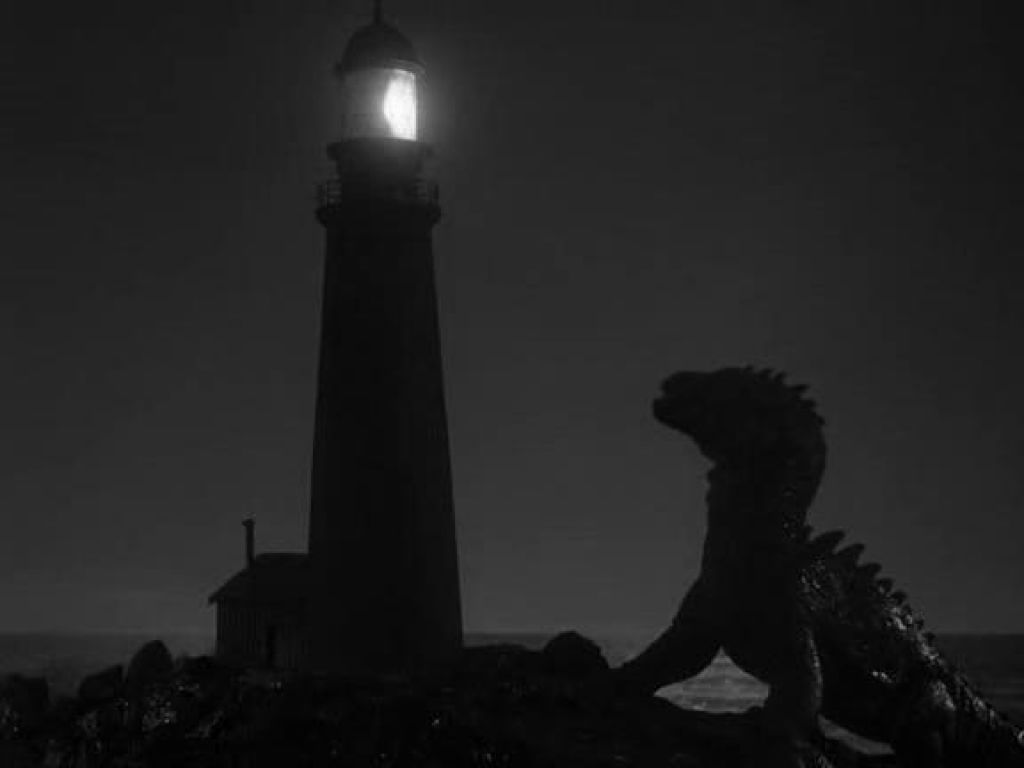
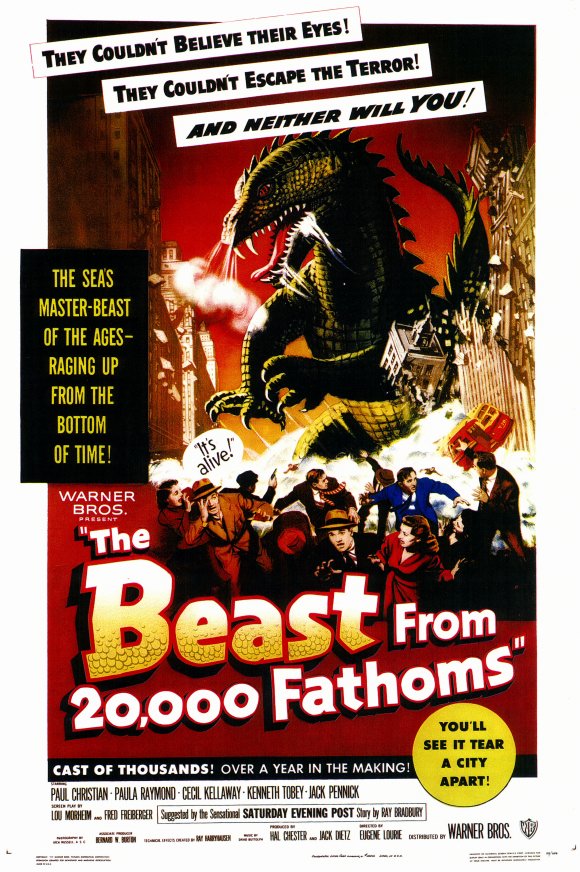
The first time it happened, I was four, and it was the stolen pleasure of sneaking downstairs late at night, unable to sleep, and creeping into the armchair in the living room while the grownups watched The Beast From 20,000 Fathoms on TV. They knew I was there; I knew they knew; but it was okay. A secret compact between us: just this once. The beast roared its way in 40s black-and-white Harryhausen stop-motion from the Arctic wastes to the towers of New York City, and the skeletal shapes of the Coney Island rollercoasters. Even as a kid, the creature’s terrible loneliness and confusion and terror were clear, and overwhelming.

That was Bradbury’s gift: the lonely heart that beats through all of us, human and monster.

The Beast From 20,000 Fathoms

The Beast From 20,000 Fathoms was the original title of Bradbury’s extraordinary short story, The Fog Horn. When Warner Bros., who were already developing a story about a sea monster rising from the depths, optioned the story and the 20,000 Fathoms title, Bradbury changed his title, keen to differentiate the story from the movie.

In the original story, a lonely sea monster is called up from the depths by the sound of a lighthouse fog horn, mistaking it for the cries of its own kind. It had lived for centuries alone, the only one. The sound of the fog horn gave it hope that it might no longer be lonely. When the creature discovers that it will in fact continue to be alone forever, it’s a haunting, crushing moment, one that consumed the seven-year-old me.

Loneliness of the long distance monster

Through the movie and the short story, Bradbury opened my mind to the raw emotional potential and power of story; the way an emotional moment can be  a devastating engine for storytelling. Brilliance of concept was not enough; every story must have a heart that beats through it, and through you, the reader. You need to feel its heart pounding in the race of your own pulse. Bradbury’s genius was in refracting these moments through awesomely pulpy genre material. These two works were key in my own evolution as a storyteller. My love of heart and of genre as a reader and a writer has its roots in Bradbury’s beautiful, lonely visions.

Powerful, heady stuff for a young mind; many years later, it still reverberates, hypnotizes, and inspires. Bradbury was unique, and I owe him a debt of gratitude for being a great teacher, and an incredible visionary and writer.

We Have A Hulk: How The Avengers Took Over The World

Wow.

I mean… Wow.

Whether you were a total Whedonite, or just a Buffy or Firefly fan, or someone who knew he did that vampire thing but didn’t know about the comic books or web shows, or you just weren’t a fan of Joss Whedon at all, it was impossible not to kneel before The Avengers as though it was an all-powerful demigod demanding your allegiance. In a good way.

Kneel!

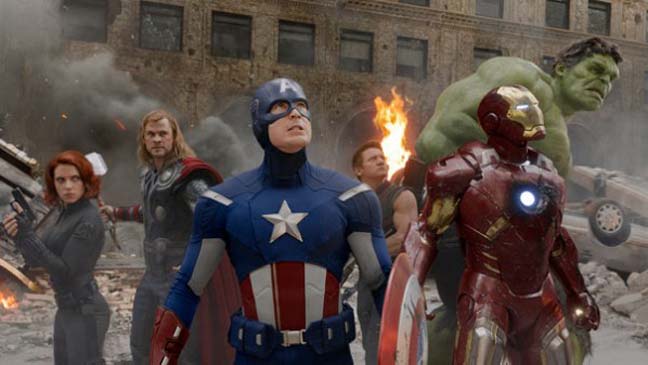
What a remarkable achievement this movie was on each and every level. Never before has a franchise been born character by character before being pulled together into one massive, all-conquering whole. For that we can thank the unswerving vision of Marvel Studio’s head honcho, Kevin Feige. From 2008 through 2011, he shepherded Iron Man 1 & 2, Thor and Captain America into production, setting up the title characters, and weaving in Samuel L. Jackson as Nick Fury, Clark Gregg as Agent Coulson, Jeremy Renner as Hawkeye, and Scarlett Johansson as Black Widow. Each movie not only set up its lead, but also evolved the Avenger Initiative backstory a little more, through one-liners, brief glimpses of the S.H.I.E.L.D. world, and crafty post-credits stingers.

With that heavy lifting taken care of, the biggest task still remained: how to take all those characters and synthesize them into one fast-moving, massive spectacle of an event movie, while retaining the humor, soul and smarts of each of the previous installments.

Which is where Joss Whedon came in.

Joss Whedon directing Mark Ruffalo

It’s no easy thing, to keep so many characters in the mix, giving each their moment(s) to shine, without losing any of them — this is especially true when the characters in question are iconic; are all (or have the potential to be) stars of their own movies & franchises. At least, it’s usually no easy thing in the movies. In TV, on the other hand, keeping multiple character arcs rolling and interweaving as you escalate stakes and understanding is simply business as usual. Todd VanDerWerff made this point in a brilliant piece for the Onion’s AV Club. He talked about how J.J. Abrams, another TV superstar-turned-movie-god, also had the same intuitive understanding as Whedon: focusing on the good guys and their interactions and emotional connections is a powerful foundation, especially in a huge movie. There are exceptions, of course, most notably Christopher Nolan’s Batman movies, which are dark and extraordinarily focused odes to isolation and loneliness (also, they’re works of utter genius). However, in the case of The Avengers, which is a high-energy, brightly-colored rock-n-roll universe, focusing on our heroes was a brilliant move on Whedon’s part.

Everyone got arcs and awesome moments (although Robert Downey Jr may have had a few more than most, knocking them all out of the park). Whedon found a way to humanize each of his heroes (most poignantly using “the cellist” and the trading cards to make us care about Agent Coulson), which drew us in all the more: such care is rarely taken in tentpole pictures, and even when care is taken, it’s rarely done with such skill and charm.

The script really is a force to be reckoned with; this is writing as superpower. It begins with a boom, then rides that momentum easily as it swoops from character to character, using one to segue to another, never losing pace as it builds up the cast; then it ratchets up the stakes, the conflict, the sheer size of everything — bringing the team together then breaking them down then finding a nuanced yet brutal emotional lever to launch the massive, rollicking final third of the movie.

This juggernaut of narrative pace is shot through with constant soul, emotion, and, most importantly of all, a relentless and brilliant sense of razor-sharp wit. This may just be the greatest comedy of the year, even as it lays an early claim to blockbuster movie of the year, and possibly even highest grossing movie ever made.

Whedon brought other great grace notes to his performance as writer & director, flourishes that made the performance even more his own: casting the iconic rebel Harry Dean Stanton as a janitor (to Hulk: “son, you have a condition”); using Lou Ferrigno as the voice of the Hulk; ending the movie with Soundgarden’s first song in fifteen years.

The Avengers in action

On so many levels, The Avengers is basically a glorious expression of everything I’ve ever loved about genre and pop culture. As a child, bringing together multiple characters was simply how I did it; that’s what toys were for. In my childhood games, it wasn’t unusual for Captain Kirk to join Spiderman, Superman and the Daleks for a face off against dinosaurs (f**k off, I’m copyrighting that, it’s mine!)… so the notion of superhero team events is basically wish-fulfillment on a massive scale: thank you, Mr. Whedon, for making this match-up so much more than the sum of its parts.

But that’s enough about Joss and the boys. Let’s talk about Scarlett.

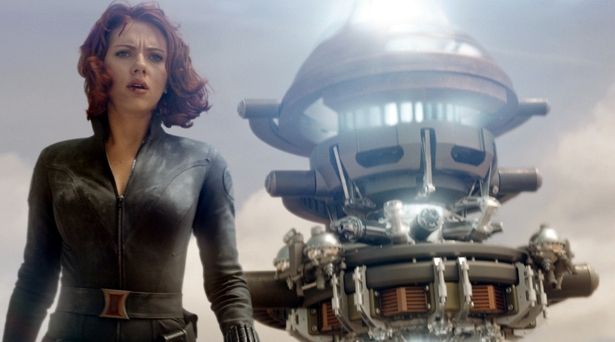
Scarlett Johansson as Black Widow in The Avengers

As the lone female, Scarlett Johansson had her work cut out. But she had Whedon on her side, one of the great feminists of pop culture, a true believer in the awesomeness and awesome power of women. Who better to make Black Widow unique and memorable, soulful and strong, kickass and funny? But having Johansson bringing Whedon’s words to life on the big screen was a truly special thing. She brought a stormy, sensual quality to the Black Widow/Natasha Romanov, playing her with a quiet strength interlaced with a hurt soulfulness, and a sharp intelligence, hidden like a knife, wielded with deadly precision and speed.

Yes, she kicked ass with the best of them, but her shivering, shaking vulnerability after just barely avoiding being killed by Hulk is just one example of what makes Natasha Romanov so human, and is one of the reasons this movie has so much heart and soul. Johansson gave the movie its warm yet broken & tortured soul. In the process, she made an airtight case for a standalone Black Widow movie.

I could keep going, but then the run time of this review would almost match the movie.

In conclusion, The Avengers was a majestic blend of humor, soulfulness, intelligence, mad thrills, and a visceral, always-building visual crescendo.

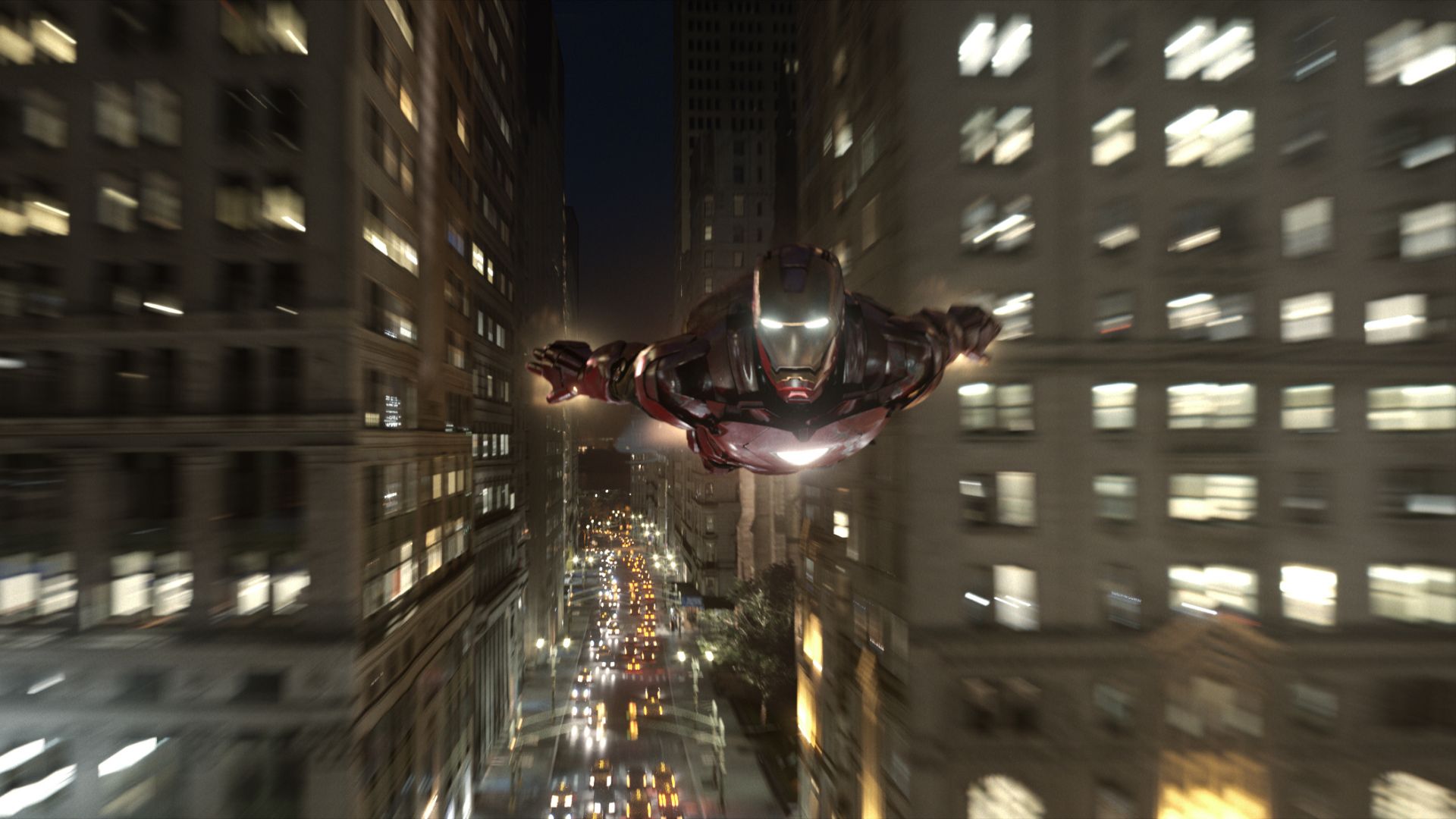
Iron Man

An extraordinary pop culture rush, in other words.

Final rating: five out of five quippy one liners.

SouthLAnd: “Thursday” — Moment Of Truth

SouthLAnd excels at forcing its characters into moments of truth.

Time slows down and a crossroads opens up before them: will they walk the righteous path, or sell their souls?

This entire season, Officer Ben Sherman has been following a path that lead him to the deadly decision: what kind of cop is he going to be? Each choice he’s made so far has taken him deeper into the darkness. By the end of God’s Work, he didn’t recognize who he was any more. Without that self-knowledge, his moral markers were gone, and no matter how hard Sammy tried, Sherman really had gone past the point of no return.

And in this episode, writer Jonathan Lisco and director Chris Chulack went full Taxi Driver to make sure Sherman went all the way over the edge.

Lisco’s script was flint-sharp and ruthless. Always an extremely emotionally and conceptually precise writer, here Lisco was even more ferocious with his dialogue and action. Every line had urgency; every beat ratcheted you closer to the end. The scenes were sharpened to deadly points and lethal edges. Such was the intelligence underlying the script that by the time Lydia walked into that hospital room where the burned child lay helpless, no dialogue was even needed as Lisco and Chulack gave us one of the single most upsetting images we’ve ever seen on this show.

SouthLAnd will devastate you with an almost casual ease.

While Sherman was off choking hookers for information, Cooper had to endure Tang’s frankly unendurable “last day on patrol” smugness. Much as I can’t disapprove of any reference to Nicki Minaj’s far-too-awesome Superbass, it was tough to watch Tang torturing that kid. If ever a Cooper “hey numbnuts” was needed, it was here. Likewise with getting Cooper to take her picture in front of the Hollywood sign. So the showdown near the end where Cooper lost it on her was a great SouthLAnd moment. Cudlitz deployed his emotional gravitas to punishing effect, while Lucy Liu gave it right back — she has done a tremendous job this season, holding her own scene for scene with an unfussy, powerful, stripped-back performance.

It was an episode of heavyweight performances.

Regina King broke our hearts, again. She does it so well, so simply. “What we do, it’s hard enough to not let it get to you… now it’s like it’s going in too deep. And if it is, where’s it going?”

Shawn Hatosy did incredible, soulful work. Even confined to a hospital bed at the start, and a deckchair by the pool at the end, he harnessed his “raging bull” energy and radiated it throughout both scenes. I pointed out a few weeks back that Hatosy has a unique way of prowling around a scene with restless, hungry energy; as SouthLAnd superfan Deb @bluegrassbabe3 pointed out today, even when Hatosy is sitting down, he’s still prowling; such is his presence. He’s a great, great actor.

But there’s no doubt that the episode belonged to Ben McKenzie. His portrayal of a man whose soul is being steadily stripped away was bleak, raw, understated and unflinching. He showed us an officer who shattered his previous self, and now has to find his way through the fragments of what he used to be. By the time that the episode closed with Sherman sitting back at the pool party as the Stones’ Street Fighting Man played on the soundtrack (spot-on song choice, and only the fourth or so time the show has used a song), it was as though he was settling in to his new existence. I’m not sure what’s more terrifying/devastating — that he lost himself to the darkness, or that he’s actually getting comfortable with it. Either way, it’s brilliant writing, setting up some great Bryant/Sherman story possibilities for season five.

Throughout the episode, Chris Chulack directed with a ruthless eye, as Jimmy Muro gave us a bleakly lit, cloudy, steely L.A. Chulack’s visceral style was honed to an even sharper edge than usual. If Sherman went racing round a corner, the camera would steadily follow him, like a shark, deadly and unstoppable. Everything was stripped back to an absolute purity of purpose. There were no skateboarding interludes in this episode. Just a ferociously relentless commitment to the truth.

Which is what this show has always been about. It’s why we love it.

It’s why SouthLAnd is one of the greatest TV dramas of our time, of any time. It’s why TNT has to renew it for an extended season 5. It’s why Warner Bros. really, really needs to release a deluxe Blu Ray box set with extended directors cuts, commentaries from writers, cast and crew, behind the scenes and the like — trust me, WB and TNT, if that box set comes out in enough time for new viewers to watch all four seasons prior to the season five opening episode, your ratings will be extraordinary. Can you imagine The Walking Dead or Game Of Thrones or Mad Men not being on DVD?

Exactly.

It’s been an amazing season four. The writers, the cast, the crew — they’ve all excelled themselves, raising the bar yet again, like this show always does. SouthLAnd is better than its ever been — which is rare for a fourth season. It’s rolling hard. And it leaves no doubt that season five would be the greatest yet.

Thank you to everyone involved with the show. I was fortunate enough to meet the cast and crew in L.A. recently; they are an incredibly smart, humble, hardworking, talented bunch, all utterly commited to making this show the best on TV.

It’s working.

I can’t wait to to tune in next year and hear once more, this is A36, show us handling.